Hamasa Ibn Gharib
March 4, 2026, Photo © Viviane Demont
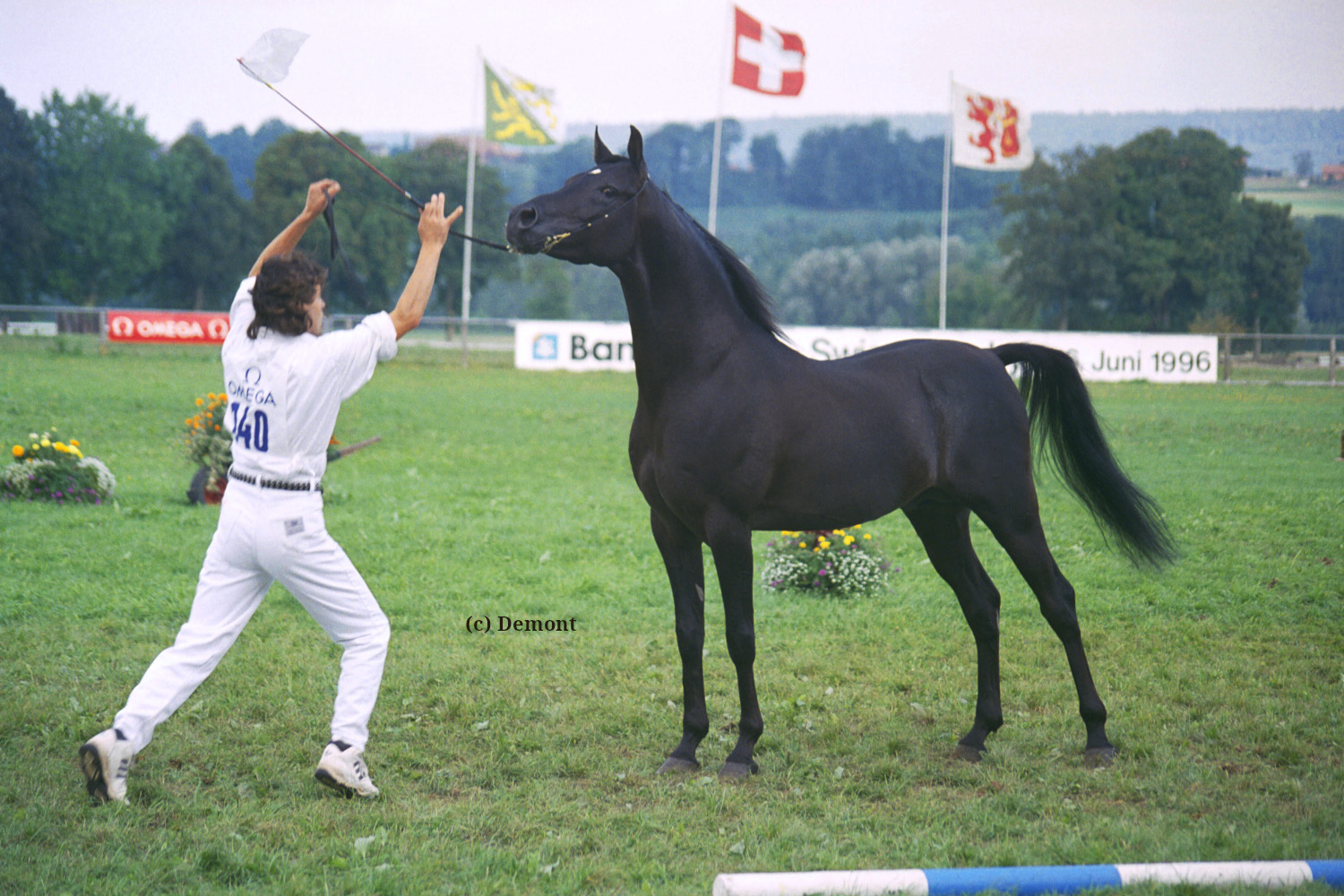
Hamasa Ibn Gharib
When Dr. Walter Georg Olms founded his Hamasa Stud in 1969 in Treis near Gießen, Germany, his vision was neither commercial nor fashionable. As a publisher by profession and a preservationist by conviction, Olms was guided by a singular objective: to safeguard the asil Arabian horse in pedigree, type, and character, tracing faithfully to authentic desert sources. The decisive cornerstone of this vision was the importation of the mare Faziza from the United States.
Faziza, acquired from Dr. Krausnick in Lamar, Colorado, carried the celebrated Babson preservation blood—rooted in imports from Egypt and tracing further to the breeding of Lady Anne Blunt and the desert tribes. By Fa-Turf (100% Babson bred) and out of Azyya by Jamil (bred by Lady Anne Blunt), Faziza united the American Babson program with early Blunt and desert foundations. Through her, the names of Henry Babson and General J.M. Dickinson entered German breeding in concentrated form. At Hamasa Stud, Faziza became a true foundation mare, producing the full brothers Tufail and Farouss (both by Kaisoon) and the mare Hamasa Bint Faziza. Her influence would echo decisively in the next generation.
One of the most important results of this carefully constructed program was Hamasa Tumaderah (1975), a black daughter by Tufail and out of Shar Duda (Negem x Shar Hiba). Significantly, Shar Duda—like Faziza—was bred by Dr. Krausnick in Lamar, Colorado, and imported by Dr. Olms to Germany as part of his early foundation band.
hrough Negem—himself 100% Babson bred—and through Shar Hiba’s combination of Fa-Turf and pure Davenport blood, Hamasa Tumaderah embodied a rare density of preservation lines. She was the only black offspring among twelve foals of Shar Duda, and she would become one of the most significant broodmares of the stud.
Bred to the black Egyptian stallion Gharib (1965), Hamasa Tumaderah produced Hamasa Ibn Gharib in 1987.
Gharib, imported to Germany in 1970 and stationed at the State Stud of Marbach, had already proven himself a corrective force in European breeding. A son of Anter and out of Souhair, he reinforced older Ibn Rabdan lines, restored pigment, and transmitted elastic, ground-covering movement combined with soundness and rideability. His influence extended into sport horse breeding, valued for structural correctness and functional athleticism.
The athletic potential of this cross was demonstrated most spectacularly by Hamasa Ibn Gharib's full brother, Hamasa Gharbi (1982), a black stallion who became German National Champion in single-horse endurance driving three times. Covering 90 kilometers in 4 hours and 26 minutes in his most celebrated victory, he exemplified the hardness, stamina, and mental composure that preservation breeders sought to maintain.
Hamasa Ibn Gharib inherited this athletic constitution, which made him interesting for non Arabian breeders, too. So he sired also warmbloods. In purebred breeding, Hamasa Ibn Gharib unfortunately only sired a modest number of offspring between 1993 and 2007. His line has not continued in registered breeding and seems to be distinct now.
Faziza, acquired from Dr. Krausnick in Lamar, Colorado, carried the celebrated Babson preservation blood—rooted in imports from Egypt and tracing further to the breeding of Lady Anne Blunt and the desert tribes. By Fa-Turf (100% Babson bred) and out of Azyya by Jamil (bred by Lady Anne Blunt), Faziza united the American Babson program with early Blunt and desert foundations. Through her, the names of Henry Babson and General J.M. Dickinson entered German breeding in concentrated form. At Hamasa Stud, Faziza became a true foundation mare, producing the full brothers Tufail and Farouss (both by Kaisoon) and the mare Hamasa Bint Faziza. Her influence would echo decisively in the next generation.
One of the most important results of this carefully constructed program was Hamasa Tumaderah (1975), a black daughter by Tufail and out of Shar Duda (Negem x Shar Hiba). Significantly, Shar Duda—like Faziza—was bred by Dr. Krausnick in Lamar, Colorado, and imported by Dr. Olms to Germany as part of his early foundation band.
hrough Negem—himself 100% Babson bred—and through Shar Hiba’s combination of Fa-Turf and pure Davenport blood, Hamasa Tumaderah embodied a rare density of preservation lines. She was the only black offspring among twelve foals of Shar Duda, and she would become one of the most significant broodmares of the stud.
Bred to the black Egyptian stallion Gharib (1965), Hamasa Tumaderah produced Hamasa Ibn Gharib in 1987.
Gharib, imported to Germany in 1970 and stationed at the State Stud of Marbach, had already proven himself a corrective force in European breeding. A son of Anter and out of Souhair, he reinforced older Ibn Rabdan lines, restored pigment, and transmitted elastic, ground-covering movement combined with soundness and rideability. His influence extended into sport horse breeding, valued for structural correctness and functional athleticism.
The athletic potential of this cross was demonstrated most spectacularly by Hamasa Ibn Gharib's full brother, Hamasa Gharbi (1982), a black stallion who became German National Champion in single-horse endurance driving three times. Covering 90 kilometers in 4 hours and 26 minutes in his most celebrated victory, he exemplified the hardness, stamina, and mental composure that preservation breeders sought to maintain.
Hamasa Ibn Gharib inherited this athletic constitution, which made him interesting for non Arabian breeders, too. So he sired also warmbloods. In purebred breeding, Hamasa Ibn Gharib unfortunately only sired a modest number of offspring between 1993 and 2007. His line has not continued in registered breeding and seems to be distinct now.