Knopka
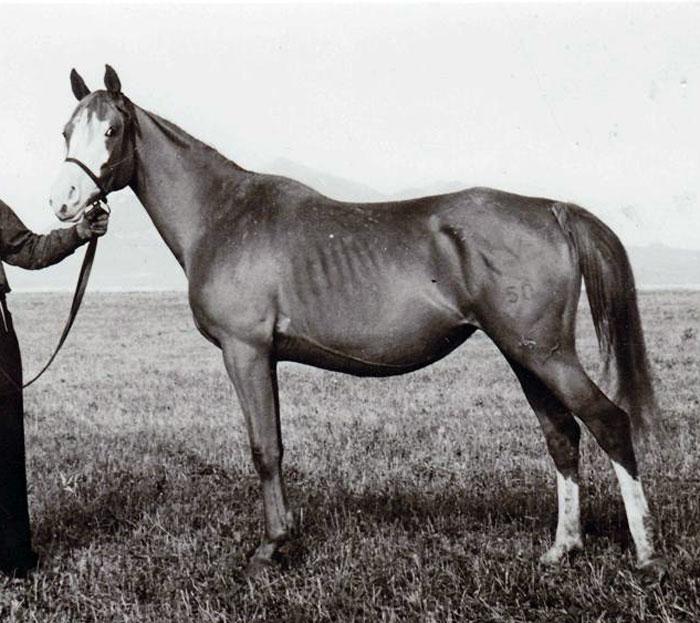
Photo archive
Horse Information
- Sex: mare
- Color: chestnut sabino
- Born: 1950-01-30
- Died: 1965
- Reg#: RASB 762
Pedigree
- Sire: Korej
- Dam: Orientacia
- Sire Line: Denouste (via Korej)
- Dam Line: Dafina db
- Branch: Ryama
- Strain: Koheylah Krushiyah
Additional Information
her name "Кнопка" means "button", "pin" or "key"
Breeder
About Knopka
Knopka was a chestnut mare with abundant white markings, or “chrome”, a striking feature that would reappear in later generations of her family. She was foaled in 1950 at Tersk Stud, where she was bred and owned.
Knopka raced at two and three years of age, making 14 starts at Pyatigorsk. Her record was five wins, two seconds, two thirds, no fourths, and five other placings.
Knopka’s sire, Korej (1939), was one of the important stallions of the early Tersk breeding program. A chestnut standing 151 cm (14.3 hands), he was bred at Tersk from the French-bred Kann (1927) and the mare Rixalina (1929). His sire Kann was by Denouste, a son of the desert-bred Latif, while his dam Rixalina was a daughter of Raseem and Rissla, both bred at Crabbet Park. Korej was therefore 50 percent Crabbet by pedigree.
Korej was not only important as a sire but was himself a performance horse. He raced at two and completed an 800-kilometre journey under saddle in 21 days. His influence at Tersk was considerable: he left more than 200 registered offspring, with several sons and daughters retained for breeding.
Among his sons, Kankan (1954), Knippel (1954) and Mak (1956) became particularly significant. Kankan, out of the Naseem daughter Nagrada, established an important branch of the Korej sire line. Among his notable sons were Persik, an influential sire of endurance champions; Prizrak, sire of European Champion Stallion Drug; and Lak, winner of the Russian Derby.
Knippel, out of Parfumeria, was an outstanding long-distance racer, winning 16 of his 25 recorded starts and setting a 7,000-metre record of 8:59.7, according to the Russian Arabian Horse Breeders Association (RAHBA).
The chestnut Mak, out of Madila, likewise founded a continuing male line in Russia through his son Kumir.
Korej’s influence was not limited to his sons. Several of his daughters established female lines that remained important in Russian and international Arabian breeding for generations. Among them was Prowarda (1958), whose daughter Prowizja (1964), by Ego, became dam of a number of U.S. National Champions, among them Ibn Prowizja.
Another important daughter was Kanitel (1946). Her daughter Kapella (1957), by Priboj, became the dam of Karta (1962) by Arax. Karta was an exceptionally influential broodmare whose offspring included Kilimandscharo, by Aswan, who became German National Champion Stallion in 1978; Karinka, whose descendants included the internationally successful stallion Drug; and Kosmetika, by Muscat, who became the dam of World Champion Stallion Kubinec.
Knopka’s dam, Orientacia, was a daughter of the Polish producer Ofir and the Crabbet mare Neamis, by Naseem out of Ryama. Orientacia had four registered foals—two colts and two fillies—but it was Knopka who carried her family forward. Orientacia did not race and was later transferred to the Malko-Kabardinsky Stud Farm; no further offspring were registered after 1951.
Knopka’s importance at Tersk was ultimately determined by what she produced. Between 1955 and 1964, six foals were registered from her: Konoplia by Negatiw; Kapriz and Krepysh, both by Priboj; Kapel and Kopirka, both by Pomeranets; and Kaia by Semen.
According to the RAHBA, Knopka was awarded "Elite" in 1963. As five of her six foals had already been produced by that time, it is reasonable to assume that the quality of her progeny was an important factor in this assessment of her breeding value. Her most enduring influence, however, would come through Kapel, whose descendants carried Knopka’s family far beyond Tersk.
Through Kapel and her daughter Kapelka, Knopka’s family eventually produced a continuation of the legacy, including Kilimandscharo, Kilifa and, several generations later, Padrons Psyche.
Another important branch, particularly significant for Russian Arabian racing, was established by Knopka’s daughter Kaia (also recorded as Kaya or Kaija), by Semen. Kaia was herself an outstanding race mare, winning the Russian Oaks in 1967 and finishing second in the Summer Prize. Her descendants continued the performance line: her daughter Kameia (Kameya), by Mastak, won the Russian Oaks as well as several major stakes and testing prizes, while Kaia's son Kuveit, by Topol, making 32 starts (10-12-5-4) and winning the Russian Derby in 1978.
The family remained an important racing line at Khrenovoe Stud, where it continued to produce high-class Arabian racehorses. Three stallions from this maternal family were standing at the stud, representing some of its best racing achievements: Kai, by Anchar out of Kameia, Duglas, by Gepard out of Dikusha, a Derby winner, and Drager, by Gepard out of Djimma, who was named Russian Arabian Racehorse of the Year in 2005.
Through Padrons Psyche and his descendants, and through the important Kaia family at Khrenovoe Stud, Knopka’s influence remains present in modern Arabian horses today—a remarkable continuation of the legacy of a Tersk mare foaled more than seven decades ago.
Knopka raced at two and three years of age, making 14 starts at Pyatigorsk. Her record was five wins, two seconds, two thirds, no fourths, and five other placings.
Knopka’s sire, Korej (1939), was one of the important stallions of the early Tersk breeding program. A chestnut standing 151 cm (14.3 hands), he was bred at Tersk from the French-bred Kann (1927) and the mare Rixalina (1929). His sire Kann was by Denouste, a son of the desert-bred Latif, while his dam Rixalina was a daughter of Raseem and Rissla, both bred at Crabbet Park. Korej was therefore 50 percent Crabbet by pedigree.
Korej was not only important as a sire but was himself a performance horse. He raced at two and completed an 800-kilometre journey under saddle in 21 days. His influence at Tersk was considerable: he left more than 200 registered offspring, with several sons and daughters retained for breeding.
Among his sons, Kankan (1954), Knippel (1954) and Mak (1956) became particularly significant. Kankan, out of the Naseem daughter Nagrada, established an important branch of the Korej sire line. Among his notable sons were Persik, an influential sire of endurance champions; Prizrak, sire of European Champion Stallion Drug; and Lak, winner of the Russian Derby.
Knippel, out of Parfumeria, was an outstanding long-distance racer, winning 16 of his 25 recorded starts and setting a 7,000-metre record of 8:59.7, according to the Russian Arabian Horse Breeders Association (RAHBA).
The chestnut Mak, out of Madila, likewise founded a continuing male line in Russia through his son Kumir.
Korej’s influence was not limited to his sons. Several of his daughters established female lines that remained important in Russian and international Arabian breeding for generations. Among them was Prowarda (1958), whose daughter Prowizja (1964), by Ego, became dam of a number of U.S. National Champions, among them Ibn Prowizja.
Another important daughter was Kanitel (1946). Her daughter Kapella (1957), by Priboj, became the dam of Karta (1962) by Arax. Karta was an exceptionally influential broodmare whose offspring included Kilimandscharo, by Aswan, who became German National Champion Stallion in 1978; Karinka, whose descendants included the internationally successful stallion Drug; and Kosmetika, by Muscat, who became the dam of World Champion Stallion Kubinec.
Knopka’s dam, Orientacia, was a daughter of the Polish producer Ofir and the Crabbet mare Neamis, by Naseem out of Ryama. Orientacia had four registered foals—two colts and two fillies—but it was Knopka who carried her family forward. Orientacia did not race and was later transferred to the Malko-Kabardinsky Stud Farm; no further offspring were registered after 1951.
Knopka’s importance at Tersk was ultimately determined by what she produced. Between 1955 and 1964, six foals were registered from her: Konoplia by Negatiw; Kapriz and Krepysh, both by Priboj; Kapel and Kopirka, both by Pomeranets; and Kaia by Semen.
According to the RAHBA, Knopka was awarded "Elite" in 1963. As five of her six foals had already been produced by that time, it is reasonable to assume that the quality of her progeny was an important factor in this assessment of her breeding value. Her most enduring influence, however, would come through Kapel, whose descendants carried Knopka’s family far beyond Tersk.
Through Kapel and her daughter Kapelka, Knopka’s family eventually produced a continuation of the legacy, including Kilimandscharo, Kilifa and, several generations later, Padrons Psyche.
Another important branch, particularly significant for Russian Arabian racing, was established by Knopka’s daughter Kaia (also recorded as Kaya or Kaija), by Semen. Kaia was herself an outstanding race mare, winning the Russian Oaks in 1967 and finishing second in the Summer Prize. Her descendants continued the performance line: her daughter Kameia (Kameya), by Mastak, won the Russian Oaks as well as several major stakes and testing prizes, while Kaia's son Kuveit, by Topol, making 32 starts (10-12-5-4) and winning the Russian Derby in 1978.
The family remained an important racing line at Khrenovoe Stud, where it continued to produce high-class Arabian racehorses. Three stallions from this maternal family were standing at the stud, representing some of its best racing achievements: Kai, by Anchar out of Kameia, Duglas, by Gepard out of Dikusha, a Derby winner, and Drager, by Gepard out of Djimma, who was named Russian Arabian Racehorse of the Year in 2005.
Through Padrons Psyche and his descendants, and through the important Kaia family at Khrenovoe Stud, Knopka’s influence remains present in modern Arabian horses today—a remarkable continuation of the legacy of a Tersk mare foaled more than seven decades ago.