Nadin
April 4, 2026, Photo © Betty Finke
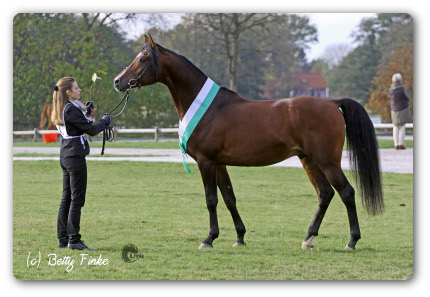
Nadin
Born in 2005 at the renowned Janow Podlaski Stud, the bay stallion Nadin represents a deliberate breeding decision rather than coincidence. His sire, Metropolis NA, was not simply imported—he was selected and brought to Poland in 2002 with a clear mission: to reintroduce the nearly lost dam line of Mammona and to reinforce the historic Kuhailan Haifi sire line. In this sense, Nadin’s story begins before his birth, rooted in a broader effort to reconnect fragmented threads of Arabian breeding history.
Metropolis NA himself embodied this fusion of history and modernity. A multiple European Sport Horse Champion between 2007 and 2012, he excelled across disciplines—Classic Pleasure, Ladies Side Saddle, Native Costume, and Type & Conformation. Such versatility is rare and speaks not only to athletic ability, but to a temperament that allows adaptation across demands. This is a trait that would later become one of Nadin’s defining strengths.
Behind Metropolis NA stands an equally compelling pedigree. His sire, Consensus, unites the elegance of Monogramm with the structural strength of Bandos through his dam Opalesce. Consensus was more than well-bred—he was highly decorated, earning titles such as U.S. National Champion in Ladies Side Saddle English and Futurity Colt, as well as Reserve Champion Stallion. His pedigree reaches back to the Kuhailan Haifi line, one of the most influential and enduring sire lines in Arabian history, known for substance, athleticism, and resilience.
If the sire line provides the narrative of restoration and refinement, Nadin’s dam line offers depth, strength, and continuity. His dam, Nana, is a daughter of Fawor and the last daughter of the esteemed Nejtyczanka, a mare of merit at Kurozweki State Stud. Nejtyczanka produced 18 foals; five of her daughters were registered as broodmares: Nizina (1981, by Aloes), Nimfa (1985), Nostalgia (1987, by Partner) both began their breeding career at Kurozweki before transferred to Bialka, Nota (1993, by Brokat) and Nagroda (1994, by Partner), all contributing to the continuation of the line. In addition to her daughters, Nejtyczanka produced the notable stallion Nimb (1992, by Eukaliptus), who was used at Kurozweki and by private breeders and achieved distinction as a UK Champion Stallion in both halter and ridden classes.
Nana herself was a Bialka Junior Spring Show Champion and developed into a classic Koheilan-type mare—strong, substantial, and correct.
Through Nana, Nadin traces directly to the legendary Rodania line, one of the most influential dam lines in Arabian breeding, originating from the Anazeh Ruala tribe and later foundational to Crabbet and Polish programs. This lineage is synonymous with durability, broodmare excellence, and generational reliability—traits that often prove more valuable over time than fleeting show-ring trends.
Physically, Nadin reflects this carefully constructed heritage. He presents a harmonious balance: a well-shaped neck set high and clean, a strong topline, and a correct, solid foundation. His conformation speaks of functionality—nothing exaggerated, nothing compromised. There is a clarity in his structure that aligns with his performance record: four successful years on the racetrack in Poland from 2008 to 2011, followed by successfully passing performance testing. This is a stallion whose body has been tested, not just admired.
His achievements did not end with racing. In 2012, Nadin was awarded the VZAP Gold Premium and named Reserve Champion at the licensing in Luhmühlen—an exceptional distinction, especially as he was one of only two stallions that year to receive both licensing and gold premium. Later, in 2015, he placed among the Top Five in L-level dressage at the European Championships in Janow Podlaski, further underscoring his versatility.
Under saddle, whether in dressage or western riding, Nadin shows the same qualities that define him on paper: willingness, attentiveness, and a calm, cooperative nature. This temperament is not incidental—it is consistently passed on to his offspring, along with strong conformation, good movement, and a clear orientation toward being a riding horse.
In Nadin, the intentions behind his pedigree have come to fruition. He is not merely the product of important bloodlines, but a confirmation that those lines—Metropolis NA, Consensus, Rodania—still matter when combined with purpose. His legacy is not defined by extremes, but by balance: between history and modern sport, between type and function, and between presence and reliability.
Such stallions rarely dominate headlines. Instead, they shape breeding programs quietly, generation by generation—exactly where their true value lies.
Metropolis NA himself embodied this fusion of history and modernity. A multiple European Sport Horse Champion between 2007 and 2012, he excelled across disciplines—Classic Pleasure, Ladies Side Saddle, Native Costume, and Type & Conformation. Such versatility is rare and speaks not only to athletic ability, but to a temperament that allows adaptation across demands. This is a trait that would later become one of Nadin’s defining strengths.
Behind Metropolis NA stands an equally compelling pedigree. His sire, Consensus, unites the elegance of Monogramm with the structural strength of Bandos through his dam Opalesce. Consensus was more than well-bred—he was highly decorated, earning titles such as U.S. National Champion in Ladies Side Saddle English and Futurity Colt, as well as Reserve Champion Stallion. His pedigree reaches back to the Kuhailan Haifi line, one of the most influential and enduring sire lines in Arabian history, known for substance, athleticism, and resilience.
If the sire line provides the narrative of restoration and refinement, Nadin’s dam line offers depth, strength, and continuity. His dam, Nana, is a daughter of Fawor and the last daughter of the esteemed Nejtyczanka, a mare of merit at Kurozweki State Stud. Nejtyczanka produced 18 foals; five of her daughters were registered as broodmares: Nizina (1981, by Aloes), Nimfa (1985), Nostalgia (1987, by Partner) both began their breeding career at Kurozweki before transferred to Bialka, Nota (1993, by Brokat) and Nagroda (1994, by Partner), all contributing to the continuation of the line. In addition to her daughters, Nejtyczanka produced the notable stallion Nimb (1992, by Eukaliptus), who was used at Kurozweki and by private breeders and achieved distinction as a UK Champion Stallion in both halter and ridden classes.
Nana herself was a Bialka Junior Spring Show Champion and developed into a classic Koheilan-type mare—strong, substantial, and correct.
Through Nana, Nadin traces directly to the legendary Rodania line, one of the most influential dam lines in Arabian breeding, originating from the Anazeh Ruala tribe and later foundational to Crabbet and Polish programs. This lineage is synonymous with durability, broodmare excellence, and generational reliability—traits that often prove more valuable over time than fleeting show-ring trends.
Physically, Nadin reflects this carefully constructed heritage. He presents a harmonious balance: a well-shaped neck set high and clean, a strong topline, and a correct, solid foundation. His conformation speaks of functionality—nothing exaggerated, nothing compromised. There is a clarity in his structure that aligns with his performance record: four successful years on the racetrack in Poland from 2008 to 2011, followed by successfully passing performance testing. This is a stallion whose body has been tested, not just admired.
His achievements did not end with racing. In 2012, Nadin was awarded the VZAP Gold Premium and named Reserve Champion at the licensing in Luhmühlen—an exceptional distinction, especially as he was one of only two stallions that year to receive both licensing and gold premium. Later, in 2015, he placed among the Top Five in L-level dressage at the European Championships in Janow Podlaski, further underscoring his versatility.
Under saddle, whether in dressage or western riding, Nadin shows the same qualities that define him on paper: willingness, attentiveness, and a calm, cooperative nature. This temperament is not incidental—it is consistently passed on to his offspring, along with strong conformation, good movement, and a clear orientation toward being a riding horse.
In Nadin, the intentions behind his pedigree have come to fruition. He is not merely the product of important bloodlines, but a confirmation that those lines—Metropolis NA, Consensus, Rodania—still matter when combined with purpose. His legacy is not defined by extremes, but by balance: between history and modern sport, between type and function, and between presence and reliability.
Such stallions rarely dominate headlines. Instead, they shape breeding programs quietly, generation by generation—exactly where their true value lies.