Eco
April 16, 2026, Photo archive
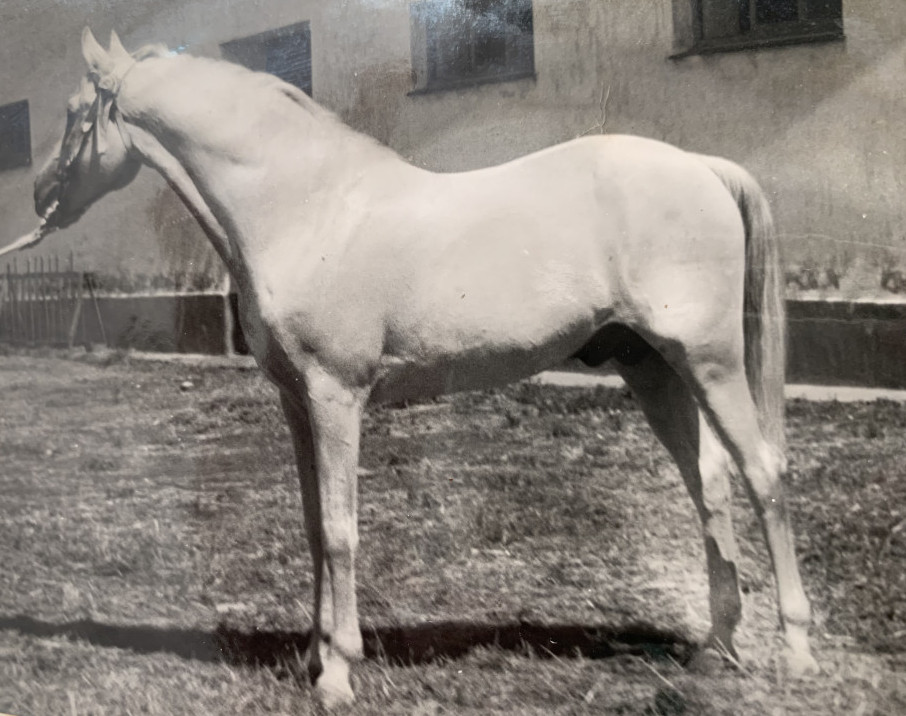
Eco
The foundations of the Spanish Arabian breeding program in the early twentieth century were built upon a carefully selected group of desert-bred imports. Among these, the mare Bint (1902) holds particular importance. Imported to the Yeguada Militar from Syria in 1905, Bint was a grey mare of the Koheylah Sadah strain. Through her daughter Varsovia, she established a female line that would play a significant role in shaping the emerging Spanish population.
Varsovia (1913) was a large mare for her time at approximately 15.2 hands and sired by Wan Dick (Van Dyck). She produced nine registered foals, among them her most important son: Eco, born in 1919.
Eco emerged during a critical phase in the development of the breed in Spain, when the initial imports were being consolidated into a distinct national type. His sire Seanderich (1902–1923) was a grey stallion of Saklawi strain imported in 1908.
As a chief sire at the Yeguada Militar, Eco produced a small number of foals but one of them was a very important: Barquillo (1938).
Barquillo represented the principal continuation of Eco’s sire line and stood as a pivotal figure in mid-twentieth century Spanish breeding. Through him, the genetic contribution of Seanderich was not only preserved but expanded. His sons, including Orive (1951), ensured the survival of this line, which continued through Orive’s son Garbo (1965), a widely used stallion within the state program. This sequence—Seanderich to Eco, Eco to Barquillo, and onward through Orive and Garbo—illustrates a coherent and sustained sire-line strategy that underpinned the development of the Spanish Arabian.
Beyond his role in the male line, Barquillo also exerted significant influence through his daughters. Among them, Uyaima, who was the dam of Estopa. Estopa stands as one of the most important mares in modern Spanish breeding. This grey mare became internationally renowned as the dam of El Shaklan, a stallion of global significance whose influence extended far beyond Spain.
While Barquillo carried Eco’s influence forward through the male line, Eco’s daughter Cibeles represented an equally important, though often less emphasized, dimension of his contribution: the maternal line. Through successive generations—Sandalia II, Dalia IV, Grazalema, and Medina Azahara—this lineage was preserved with remarkable continuity.
Its significance becomes evident in the pedigree of the modern international sire Magnum Psyche (1995–2023). A United States National Champion and one of the most influential stallions of the late twentieth and early twenty-first centuries, Magnum Psyche traces in direct tail-female line to Cibeles.
Eco thus occupies a distinct position in the history of the Spanish Arabian horse. His male descendants secured the continuity of a dominant sire line, while his female line extended into modern breeding at the highest level. In this dual capacity, Eco stands as a key figure in the transformation of imported desert blood into a stable and enduring Spanish identity—one whose influence continues to be felt well into the present day, long after his death in 1947.
Varsovia (1913) was a large mare for her time at approximately 15.2 hands and sired by Wan Dick (Van Dyck). She produced nine registered foals, among them her most important son: Eco, born in 1919.
Eco emerged during a critical phase in the development of the breed in Spain, when the initial imports were being consolidated into a distinct national type. His sire Seanderich (1902–1923) was a grey stallion of Saklawi strain imported in 1908.
As a chief sire at the Yeguada Militar, Eco produced a small number of foals but one of them was a very important: Barquillo (1938).
Barquillo represented the principal continuation of Eco’s sire line and stood as a pivotal figure in mid-twentieth century Spanish breeding. Through him, the genetic contribution of Seanderich was not only preserved but expanded. His sons, including Orive (1951), ensured the survival of this line, which continued through Orive’s son Garbo (1965), a widely used stallion within the state program. This sequence—Seanderich to Eco, Eco to Barquillo, and onward through Orive and Garbo—illustrates a coherent and sustained sire-line strategy that underpinned the development of the Spanish Arabian.
Beyond his role in the male line, Barquillo also exerted significant influence through his daughters. Among them, Uyaima, who was the dam of Estopa. Estopa stands as one of the most important mares in modern Spanish breeding. This grey mare became internationally renowned as the dam of El Shaklan, a stallion of global significance whose influence extended far beyond Spain.
While Barquillo carried Eco’s influence forward through the male line, Eco’s daughter Cibeles represented an equally important, though often less emphasized, dimension of his contribution: the maternal line. Through successive generations—Sandalia II, Dalia IV, Grazalema, and Medina Azahara—this lineage was preserved with remarkable continuity.
Its significance becomes evident in the pedigree of the modern international sire Magnum Psyche (1995–2023). A United States National Champion and one of the most influential stallions of the late twentieth and early twenty-first centuries, Magnum Psyche traces in direct tail-female line to Cibeles.
Eco thus occupies a distinct position in the history of the Spanish Arabian horse. His male descendants secured the continuity of a dominant sire line, while his female line extended into modern breeding at the highest level. In this dual capacity, Eco stands as a key figure in the transformation of imported desert blood into a stable and enduring Spanish identity—one whose influence continues to be felt well into the present day, long after his death in 1947.