Taraszcza
April 14, 2026, Photo archive
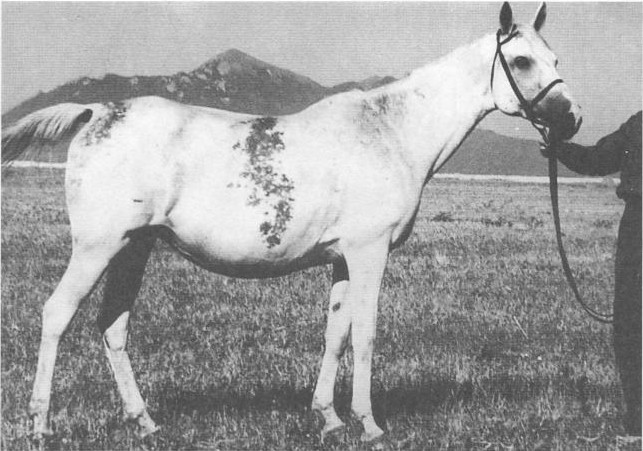
Taraszcza
Taraszcza, a grey mare foaled in 1937 Janow Podlaski in Poland, stands among the most historically significant daughters of the Polish foundation mare Gazella II.
A refined but plainly built grey mare of moderate size, Taraszcza shows a classic, straight head, slightly long neck, and functional, somewhat light frame. Her conformation emphasizes utility over beauty, with correct limbs and a balanced body. Her distinctive identifying feature was the striking markings on her right side, which made her easy to recognize among the herd.
Though contemporary witnesses described her as small, she would go on to become one of the greatest broodmares of the 20th century Arabian breed.
Taraszcza was sired by Enwer Bey, a son of Abu Mlech out of Koalicja (by Koheilan IV), a stallion whose influence far exceeded his limited number of offspring. Though he sired only nine foals—four stallions and five mares—his legacy endured through a select group of highly significant descendants.
Among them, Taraszcza herself became his most important daughter. His son Trypolis gained recognition in Poland as a racehorse sire. Another notable son was Halef, making Taraszcza and Halef paternal half-siblings.
Halef (1937, out of Kasztelanka) was bred at Janów Podlaski and later became an influential stallion in Germany after World War II. Exported westward, he sired over thirty foals and contributed to the spread of Polish Arabian bloodlines in Western Europe, particularly through his daughters.
Like many horses of his generation, Enwer Bey’s career was cut short by the turmoil of World War II, and he was lost before his full breeding potential could be realized. Yet through offspring such as Taraszcza and Halef, his genetic legacy continued to shape Arabian breeding programs for decades to come.
Taraszcza’s significance is inseparable from that of her dam, Gazella II (1914), one of the most remarkable and far-reaching foundation mares in Polish Arabian breeding. Foaled at the Jezupol stud of Count Wladyslaw Dzieduszycki, she was by Kohejlan (1903) out of Abra by Anvil, representing some of the most valuable Polish bloodlines of the early twentieth century. Jezupol itself was a relatively small but exceptionally important breeding center, preserving the legacy of desert-bred mares imported in the nineteenth century—lines that would ultimately influence Arabian breeding worldwide .
Gazella II’s life unfolded against the backdrop of repeated historical upheaval. The devastation of World War I nearly erased the Jezupol herd, yet she survived and was later acquired by Henryk Przewlocki before being transferred to the Janów Podlaski Stud Farm in 1920. There, she became one of the key mares in rebuilding Polish Arabian breeding after its near destruction, contributing to a program that would regain global prominence despite further losses during World War II. She became the dam of Fryga II (1924, by Bakszysz), dam of Maskota and Ofirka, Makata (1931, by Fetysz), dam of Witraz or Najada (1932, by Fetysz), dam of Ali Said and Naganka. Just to name a few.
Taken to Tersk in Russia as a two years old, Taraszcza developed into an exceptionally reliable and productive broodmare, producing eighteen purebred Arabian foals—ten stallions and eight mares—over two decades. Such longevity and consistency alone would mark her as valuable.
Her early produce reflected the transitional phase of Tersk breeding, combining Polish mares with stallions of diverse origins. One of her first foals, the mare Operetka (1941, by Ofir), already embodied this synthesis, while Patent (1943, by Piolun) and Nitka (1944, by Naseem) continued to establish her as a dependable foundation mare within the herd.
It was, however, her repeated crossings with the Crabbet-bred stallion Naseem that proved decisive. From this combination came a series of influential offspring, most notably Negatiw (1945), who would become one of the most important sires ever bred at Tersk. A stallion of refinement and aristocratic type, Negatiw not only dominated within the Soviet program but later returned to Poland, where he revitalized sire lines and left a lasting mark on modern Arabian pedigrees worldwide.
The same cross also produced sons such as Namet (1946) and Namet II (1947), as well as the mare Nitochka (1948), who became one of Taraszcza’s most important daughters. Nitochka carried forward the maternal strength of the family within Tersk, producing offspring like Naslednik and Napersnitsa, and establishing a branch that remained active in Russian breeding for generations.
As Tersk breeding evolved, Taraszcza was paired with stallions of predominantly Soviet development, particularly Priboj, one of the pillars of the program. From these matings came a number of solid and influential horses, including Plotina (1950), Politura (1954), Tipografia (1955), and the stallion Topol (1956). Topol proved especially significant as a sire of racehorses, transmitting speed and athleticism through his descendants, including the noted stallion Naftalin.
Another important daughter from this period was Teplica (1957), who continued Taraszcza’s female line within Tersk. Through her sons, such as Trel and Teberda, she contributed to the continuity and depth of the breeding program, reinforcing the enduring presence of Taraszcza’s lineage.
Later offspring, including Tulpan (1958), Topaz (1959), and Tochenaia (1961), illustrate the remarkable span of Taraszcza’s reproductive life. Even in her later years, she remained a consistent producer, contributing to successive generations of the Tersk herd.
The Russian studbook records Taraszcza’s death in 1963, though whether this marks her true passing or only the end of her record remains uncertain.
Taraszcza was not a mare of classical beauty, but she was not one to disappear in a crowd. The striking markings along her right side set her apart, making her instantly recognizable among the herd. Carried far from her homeland by war, she never returned—but through her sons and daughters, she found her way back. In pedigrees, in breeding, and in the enduring lines she left behind, her presence remains—just as unmistakable as she once was in life.
A refined but plainly built grey mare of moderate size, Taraszcza shows a classic, straight head, slightly long neck, and functional, somewhat light frame. Her conformation emphasizes utility over beauty, with correct limbs and a balanced body. Her distinctive identifying feature was the striking markings on her right side, which made her easy to recognize among the herd.
Though contemporary witnesses described her as small, she would go on to become one of the greatest broodmares of the 20th century Arabian breed.
Taraszcza was sired by Enwer Bey, a son of Abu Mlech out of Koalicja (by Koheilan IV), a stallion whose influence far exceeded his limited number of offspring. Though he sired only nine foals—four stallions and five mares—his legacy endured through a select group of highly significant descendants.
Among them, Taraszcza herself became his most important daughter. His son Trypolis gained recognition in Poland as a racehorse sire. Another notable son was Halef, making Taraszcza and Halef paternal half-siblings.
Halef (1937, out of Kasztelanka) was bred at Janów Podlaski and later became an influential stallion in Germany after World War II. Exported westward, he sired over thirty foals and contributed to the spread of Polish Arabian bloodlines in Western Europe, particularly through his daughters.
Like many horses of his generation, Enwer Bey’s career was cut short by the turmoil of World War II, and he was lost before his full breeding potential could be realized. Yet through offspring such as Taraszcza and Halef, his genetic legacy continued to shape Arabian breeding programs for decades to come.
Taraszcza’s significance is inseparable from that of her dam, Gazella II (1914), one of the most remarkable and far-reaching foundation mares in Polish Arabian breeding. Foaled at the Jezupol stud of Count Wladyslaw Dzieduszycki, she was by Kohejlan (1903) out of Abra by Anvil, representing some of the most valuable Polish bloodlines of the early twentieth century. Jezupol itself was a relatively small but exceptionally important breeding center, preserving the legacy of desert-bred mares imported in the nineteenth century—lines that would ultimately influence Arabian breeding worldwide .
Gazella II’s life unfolded against the backdrop of repeated historical upheaval. The devastation of World War I nearly erased the Jezupol herd, yet she survived and was later acquired by Henryk Przewlocki before being transferred to the Janów Podlaski Stud Farm in 1920. There, she became one of the key mares in rebuilding Polish Arabian breeding after its near destruction, contributing to a program that would regain global prominence despite further losses during World War II. She became the dam of Fryga II (1924, by Bakszysz), dam of Maskota and Ofirka, Makata (1931, by Fetysz), dam of Witraz or Najada (1932, by Fetysz), dam of Ali Said and Naganka. Just to name a few.
Taken to Tersk in Russia as a two years old, Taraszcza developed into an exceptionally reliable and productive broodmare, producing eighteen purebred Arabian foals—ten stallions and eight mares—over two decades. Such longevity and consistency alone would mark her as valuable.
Her early produce reflected the transitional phase of Tersk breeding, combining Polish mares with stallions of diverse origins. One of her first foals, the mare Operetka (1941, by Ofir), already embodied this synthesis, while Patent (1943, by Piolun) and Nitka (1944, by Naseem) continued to establish her as a dependable foundation mare within the herd.
It was, however, her repeated crossings with the Crabbet-bred stallion Naseem that proved decisive. From this combination came a series of influential offspring, most notably Negatiw (1945), who would become one of the most important sires ever bred at Tersk. A stallion of refinement and aristocratic type, Negatiw not only dominated within the Soviet program but later returned to Poland, where he revitalized sire lines and left a lasting mark on modern Arabian pedigrees worldwide.
The same cross also produced sons such as Namet (1946) and Namet II (1947), as well as the mare Nitochka (1948), who became one of Taraszcza’s most important daughters. Nitochka carried forward the maternal strength of the family within Tersk, producing offspring like Naslednik and Napersnitsa, and establishing a branch that remained active in Russian breeding for generations.
As Tersk breeding evolved, Taraszcza was paired with stallions of predominantly Soviet development, particularly Priboj, one of the pillars of the program. From these matings came a number of solid and influential horses, including Plotina (1950), Politura (1954), Tipografia (1955), and the stallion Topol (1956). Topol proved especially significant as a sire of racehorses, transmitting speed and athleticism through his descendants, including the noted stallion Naftalin.
Another important daughter from this period was Teplica (1957), who continued Taraszcza’s female line within Tersk. Through her sons, such as Trel and Teberda, she contributed to the continuity and depth of the breeding program, reinforcing the enduring presence of Taraszcza’s lineage.
Later offspring, including Tulpan (1958), Topaz (1959), and Tochenaia (1961), illustrate the remarkable span of Taraszcza’s reproductive life. Even in her later years, she remained a consistent producer, contributing to successive generations of the Tersk herd.
The Russian studbook records Taraszcza’s death in 1963, though whether this marks her true passing or only the end of her record remains uncertain.
Taraszcza was not a mare of classical beauty, but she was not one to disappear in a crowd. The striking markings along her right side set her apart, making her instantly recognizable among the herd. Carried far from her homeland by war, she never returned—but through her sons and daughters, she found her way back. In pedigrees, in breeding, and in the enduring lines she left behind, her presence remains—just as unmistakable as she once was in life.