Babel
January 1, 2026, Photo archive
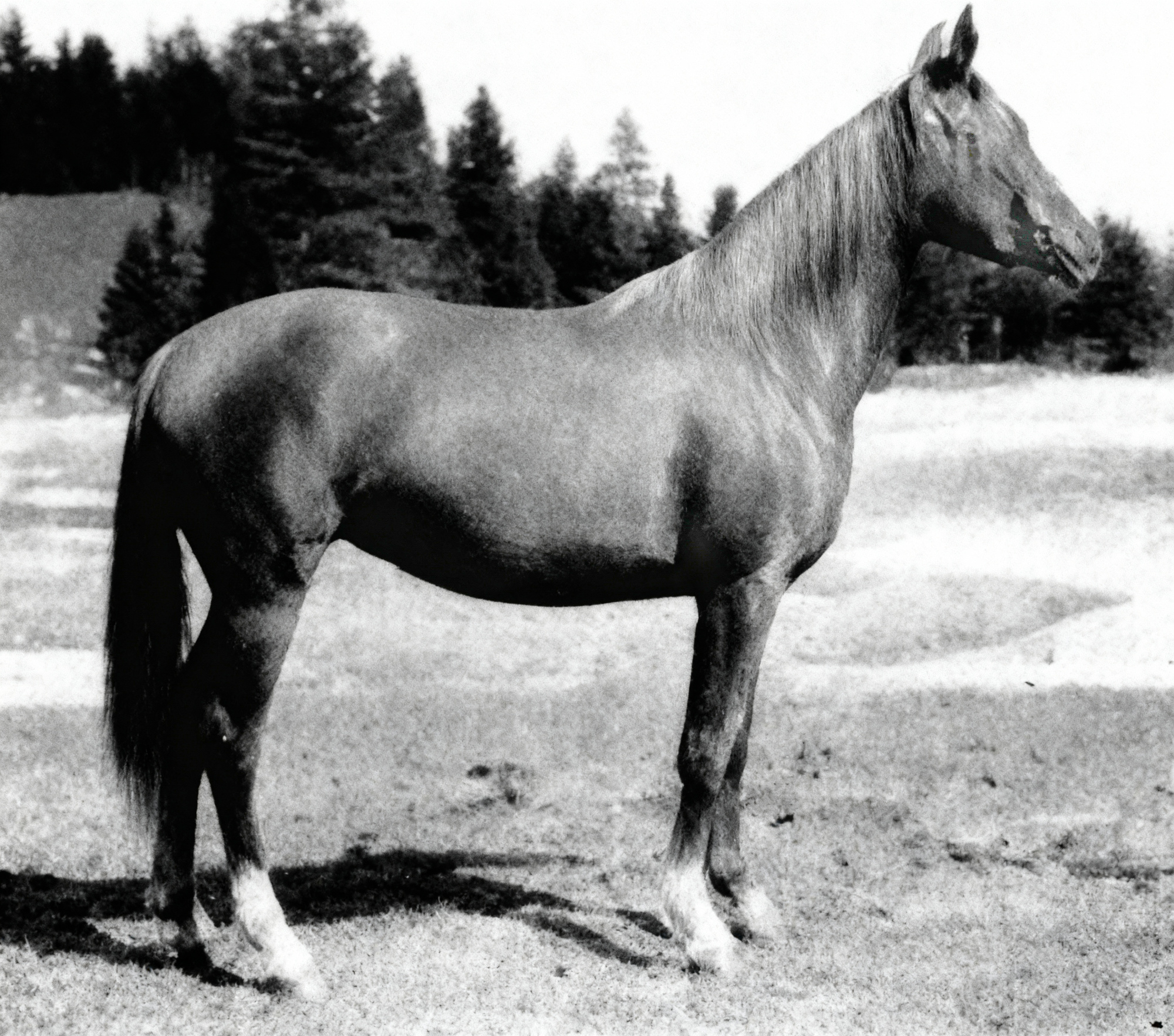
Babel
The chestnut mare Babel, foaled in France in 1921, represents one of the rarest influences in early American Arabian breeding. Bred by Miss Larrouy, Babel belonged to the small but authentic French population of Arabians that had preserved direct desert bloodlines at a time when such horses were already becoming scarce in Europe.
Babel was a foal when she was imported from France to the United States by W. R. Brown of Maynesboro Stud, New Hampshire, arriving together with her dam, Balkis II, and four other Arabians. While French-bred Arabians would later influence breeding programs elsewhere, notably in Poland, this group of six horses remains historically unique as they were only Arabian importation ever made from France to the United States.
Babel was sired by the desert-bred stallion Gadban, a bay Hamdani Simri foaled in 1902 and imported to France. Babel was his only representative in the United States, making her the sole source of this rare bloodline. From a genetic and historical standpoint, this alone places Babel in a category of exceptional importance.
Her dam, Balkis II (El Hassan x Bedadine), foaled in 1906, was herself a mare of singular distinction. Balkis II was the only representative of her sire El Hassan ever imported into the United States. Through her dam line, Babel traced to the desert-bred mare Balkis, born in 1879 and identified as Koheilah Ajuze. Although the Balkis family was never numerically large, it periodically produced individuals of notable quality.
Babel was a refined, upstanding mare with excellent withers and a notably deep heart girth. Her head was unremarkable, while her shortcomings included straight shoulders, a somewhat short neck, and shallow hindquarters with a croup lacking ideal length and levelness. As a broodmare, she often transmitted these faults—sometimes in accentuated form—except when bred to Alla Amarward, with whom she nicked exceptionally well. That union produced offspring that combined her strengths with marked improvement in balance and quality.
In 1927, W. R. Brown sold Babel to Mrs. C. Pardee Erdman of Wyoming, who bred seven foals from her. Babel proved an uneven but ultimately significant broodmare. She produced five sons and four daughters, though not all bred on. Three sons—Fandash, Hillah, and Birsha—did not reproduce. Her most influential sons were Bacaram and Ballaward, both by Alla Amarward. Bacaram, in particular, became Babel’s crowning achievement: a remarkably attractive, typey stallion widely regarded as superior even to his famous sire. Through his many sons and daughters, including the notable racer The Electrician, Bacaram ensured Babel’s widespread presence in modern pedigrees.
Babel’s direct female line survives only narrowly. Of her daughters, Bera by Babyat and Balynnward by Alla Amarward carried the family forward, with limited continuation through Bacalalba. The line persists primarily through Bera’s descendants and Balynnward’s daughter Ballyroh.
Babel occupies a clearly defined and historically measurable position in American Arabian breeding. As the only representative of the Gadban sire line ever imported to the United States, she introduced a completely unique paternal influence that has never been duplicated. Through her dam, Balkis II, she also preserved an exceptionally rare branch of the Koheilan Ajuz family. While her direct female line has remained narrow, her genetic impact has been securely carried forward through both male and female descendants, most notably through Bacaram, whose influence far exceeded the modest size of the family itself.
Babel was a foal when she was imported from France to the United States by W. R. Brown of Maynesboro Stud, New Hampshire, arriving together with her dam, Balkis II, and four other Arabians. While French-bred Arabians would later influence breeding programs elsewhere, notably in Poland, this group of six horses remains historically unique as they were only Arabian importation ever made from France to the United States.
Babel was sired by the desert-bred stallion Gadban, a bay Hamdani Simri foaled in 1902 and imported to France. Babel was his only representative in the United States, making her the sole source of this rare bloodline. From a genetic and historical standpoint, this alone places Babel in a category of exceptional importance.
Her dam, Balkis II (El Hassan x Bedadine), foaled in 1906, was herself a mare of singular distinction. Balkis II was the only representative of her sire El Hassan ever imported into the United States. Through her dam line, Babel traced to the desert-bred mare Balkis, born in 1879 and identified as Koheilah Ajuze. Although the Balkis family was never numerically large, it periodically produced individuals of notable quality.
Babel was a refined, upstanding mare with excellent withers and a notably deep heart girth. Her head was unremarkable, while her shortcomings included straight shoulders, a somewhat short neck, and shallow hindquarters with a croup lacking ideal length and levelness. As a broodmare, she often transmitted these faults—sometimes in accentuated form—except when bred to Alla Amarward, with whom she nicked exceptionally well. That union produced offspring that combined her strengths with marked improvement in balance and quality.
In 1927, W. R. Brown sold Babel to Mrs. C. Pardee Erdman of Wyoming, who bred seven foals from her. Babel proved an uneven but ultimately significant broodmare. She produced five sons and four daughters, though not all bred on. Three sons—Fandash, Hillah, and Birsha—did not reproduce. Her most influential sons were Bacaram and Ballaward, both by Alla Amarward. Bacaram, in particular, became Babel’s crowning achievement: a remarkably attractive, typey stallion widely regarded as superior even to his famous sire. Through his many sons and daughters, including the notable racer The Electrician, Bacaram ensured Babel’s widespread presence in modern pedigrees.
Babel’s direct female line survives only narrowly. Of her daughters, Bera by Babyat and Balynnward by Alla Amarward carried the family forward, with limited continuation through Bacalalba. The line persists primarily through Bera’s descendants and Balynnward’s daughter Ballyroh.
Babel occupies a clearly defined and historically measurable position in American Arabian breeding. As the only representative of the Gadban sire line ever imported to the United States, she introduced a completely unique paternal influence that has never been duplicated. Through her dam, Balkis II, she also preserved an exceptionally rare branch of the Koheilan Ajuz family. While her direct female line has remained narrow, her genetic impact has been securely carried forward through both male and female descendants, most notably through Bacaram, whose influence far exceeded the modest size of the family itself.