Dajania
February 26, 2026, Photo © Crabbet Archives
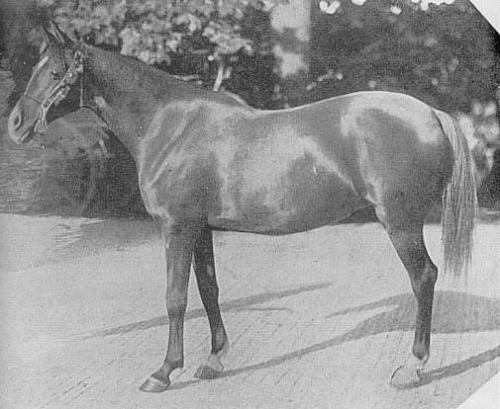
Dajania
In the spring of 1878, beneath the vast Syrian sky, a young bay mare stood at the center of negotiations that would quietly shape the future of Arabian horse breeding in Europe. She was Dajania, a bay Koheylah Dajaniyah, foaled in 1876 and bred by Mohammed Pasha, a Turkoman chief. Her dam had earlier been taken by the chief from the Anazeh Bedouins.
Dajania would become the first Arabian horse ever purchased in the desert by Wilfrid Blunt and Lady Anne Blunt—and in doing so, she would lay the first living stone of what became the world-renowned Crabbet Arabian Stud.
The Blunts encountered Dajania near Aleppo during their early travels in search of authentic desert blood.
Bright bay with black points, refined head, and strong limbs, she embodied both elegance and utility. To Lady Anne she was “Jasmine,” while Wilfrid sometimes called her “Lady Hester”—names that reflected affection as much as admiration. Yet beyond sentiment, the Blunts recognized in her the authenticity they sought: a mare of pure desert lineage, untainted and representative of a living Bedouin tradition.
On 2 July 1878, Dajania arrived in England as one of the first six horses that formed the nucleus of the newly established Crabbet Stud in Sussex.
The founding of Crabbet was more than a private passion. Wilfrid and Lady Anne Blunt envisioned a preservation project—an effort to safeguard the classical Arabian type at a moment when modernization and changing warfare threatened its survival in its homeland. Through careful documentation, selective breeding, and an insistence on authenticity, Crabbet would become one of the most influential Arabian studs in history.
For Dajania herself, however, destiny would rest not in numbers but in legacy. During her years at Crabbet, she produced three colts (two by Kars, one by Faris) and two fillies (by Hadban and Maidan respectively). Her bay daughter by Hadban, born in 1885, was named Nefisa, and it is through Nefisa that Dajania’s name would echo through generations.
Lady Anne regarded Nefisa as a “perfect brood mare,” and history proved her judgment sound. Nefisa became the matriarch of what later breeders would call the great “N line” of Crabbet. Through her daughters, especially Narghileh (1895, by Mesaoud) and Nasra (1908, by Daoud), and granddaughters (such as Nisreen by Nureddin II or Nashisha by Rasim) flowed a dynasty of mares and stallions whose names became woven into Arabian studbooks across continents. From this line emerged influential sires such as *Naseem, whose refinement and prepotency shaped breeding programs in Britain and beyond; and through subsequent generations, horses that traveled to North America, Australia, and South Africa, carrying with them the unmistakable stamp of Crabbet type.
The Dajania–Nefisa family became renowned for producing horses of balance and athleticism, with sound limbs, excellent shoulders, and the elastic movement that allowed Crabbet Arabians to excel not only in the show ring but in endurance and performance disciplines. While some desert imports left numerous offspring, Dajania’s influence demonstrates a different truth of breeding: that a single daughter, if exceptional, can anchor an entire dynasty.
The Dajania–Nefisa family became renowned for producing horses of balance and athleticism, with sound limbs, excellent shoulders, and the elastic movement that allowed Crabbet Arabians to excel not only in the show ring but in endurance and performance disciplines.
In 1886, Dajania was sold, her direct presence at Crabbet ending after eight formative years. Yet by then her most important contribution had already been secured: through her daughter Nefisa.
Dajania would become the first Arabian horse ever purchased in the desert by Wilfrid Blunt and Lady Anne Blunt—and in doing so, she would lay the first living stone of what became the world-renowned Crabbet Arabian Stud.
The Blunts encountered Dajania near Aleppo during their early travels in search of authentic desert blood.
Bright bay with black points, refined head, and strong limbs, she embodied both elegance and utility. To Lady Anne she was “Jasmine,” while Wilfrid sometimes called her “Lady Hester”—names that reflected affection as much as admiration. Yet beyond sentiment, the Blunts recognized in her the authenticity they sought: a mare of pure desert lineage, untainted and representative of a living Bedouin tradition.
On 2 July 1878, Dajania arrived in England as one of the first six horses that formed the nucleus of the newly established Crabbet Stud in Sussex.
The founding of Crabbet was more than a private passion. Wilfrid and Lady Anne Blunt envisioned a preservation project—an effort to safeguard the classical Arabian type at a moment when modernization and changing warfare threatened its survival in its homeland. Through careful documentation, selective breeding, and an insistence on authenticity, Crabbet would become one of the most influential Arabian studs in history.
For Dajania herself, however, destiny would rest not in numbers but in legacy. During her years at Crabbet, she produced three colts (two by Kars, one by Faris) and two fillies (by Hadban and Maidan respectively). Her bay daughter by Hadban, born in 1885, was named Nefisa, and it is through Nefisa that Dajania’s name would echo through generations.
Lady Anne regarded Nefisa as a “perfect brood mare,” and history proved her judgment sound. Nefisa became the matriarch of what later breeders would call the great “N line” of Crabbet. Through her daughters, especially Narghileh (1895, by Mesaoud) and Nasra (1908, by Daoud), and granddaughters (such as Nisreen by Nureddin II or Nashisha by Rasim) flowed a dynasty of mares and stallions whose names became woven into Arabian studbooks across continents. From this line emerged influential sires such as *Naseem, whose refinement and prepotency shaped breeding programs in Britain and beyond; and through subsequent generations, horses that traveled to North America, Australia, and South Africa, carrying with them the unmistakable stamp of Crabbet type.
The Dajania–Nefisa family became renowned for producing horses of balance and athleticism, with sound limbs, excellent shoulders, and the elastic movement that allowed Crabbet Arabians to excel not only in the show ring but in endurance and performance disciplines. While some desert imports left numerous offspring, Dajania’s influence demonstrates a different truth of breeding: that a single daughter, if exceptional, can anchor an entire dynasty.
The Dajania–Nefisa family became renowned for producing horses of balance and athleticism, with sound limbs, excellent shoulders, and the elastic movement that allowed Crabbet Arabians to excel not only in the show ring but in endurance and performance disciplines.
In 1886, Dajania was sold, her direct presence at Crabbet ending after eight formative years. Yet by then her most important contribution had already been secured: through her daughter Nefisa.