Gharib
January 8, 2026, Photo © Gudrun Waiditschka
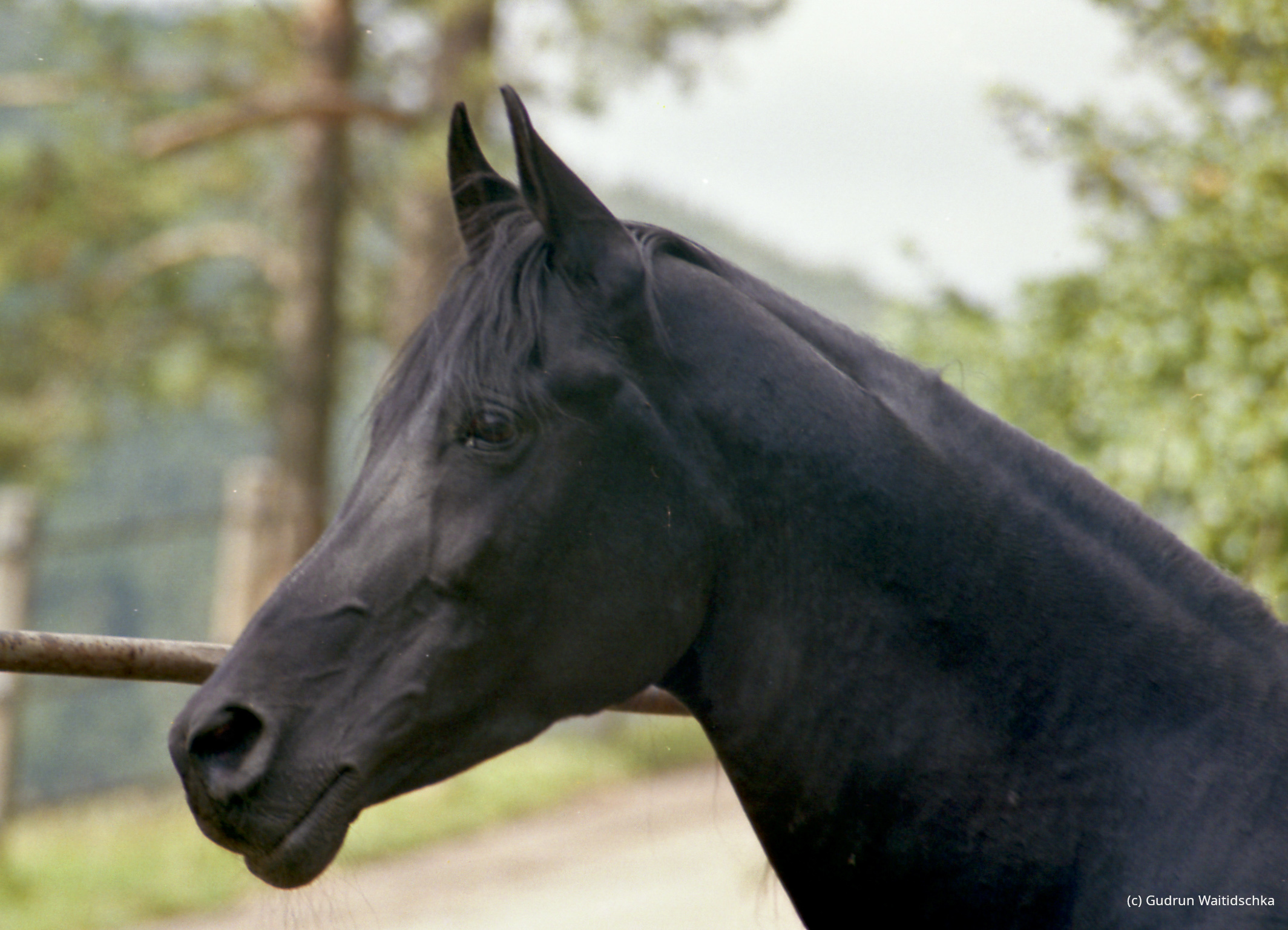
Gharib
When the black Egyptian stallion Gharib arrived at the German State Stud of Marbach in 1970, he marked a decisive turning point in the history of German Arabian breeding. Foaled in 1965 at the Egyptian State Stud El Zahraa, Gharib was imported as a deliberate outcross at a time when Marbach’s herd had become heavily concentrated in the blood of Hadban Enzahi. His influence—initially underestimated by some—would prove both profound and enduring.
Marbach’s post-war Arabian program had been revitalized in 1955 with the importation of Hadban Enzahi, a son of the legendary Nazeer. Over the years, Hadban’s prepotency shaped an entire generation of Marbach-bred Arabians. Yet by the late 1960s, it became increasingly clear that genetic diversity was urgently needed. Pigment loss, increasing relatedness, and the risks associated with intensified Nazeer-line breeding made the search for a true outcross unavoidable.
It was under these circumstances that Marbach's director Dr. Georg Wenzler traveled to Egypt in 1969 to identify a successor for Hadban Enzahi. His journey did not lead to one of the famous, already established sires of El Zahraa, but instead to a then still-developing young stallion: Gharib.
At the time of his selection, Gharib was neither the most “finished” nor the most overtly refined horse among the Egyptian stallions presented. What distinguished him, however, was unmistakable: jet-black color, absolute soundness, exceptional athleticism, and extraordinary freedom of movement. He impressed not only under observation but through action—most memorably through his natural, riderless jumping ability, which exceeded what was commonly expected of a straight Egyptian Arabian.
Gharib was sired by Anter, an Inshass-bred stallion who himself served as an outcross in Egypt. Through Anter, Gharib traced to Hamdan, the full brother of Shahloul, anchoring him firmly within one of the most respected male lines of Egyptian breeding (Ibn Rabdan – Rabdan – Dahman El Azrak). His dam was Souhair, a daughter by Sid Abouhom. Notably, Gharib carried no Nazeer blood, yet reinforced the old desert roots through multiple lines to Ibn Rabdan, who appears four times in his pedigree. Additionally, his pedigree was rich in Blunt influence, including Rustem, Kazmeen, and Astraled.
Physically, Gharib stood apart from his predecessor. Measuring approximately 1.56 m, he was tall for a straight Egyptian stallion, long-lined, athletic, and dry in structure, with good bone and a calm, balanced temperament. While different in type from the charismatic and dominant Hadban Enzahi, Gharib embodied the classic Arabian: elegance paired with substance, and beauty combined with performance capability. Contrary to Hadban Enzahi, who was not known for spectacular movement, Gharib's movement were excellent which he passed consistently to his sons and daughters. His only "fault" might be that he lacked type.
Initially, Gharib did not receive the strongest book of mares, and for several years his value was underestimated by parts of the breeding community. Over time, however, the quality and consistency of his progeny became undeniable. By 1981, he had already sired four licensed stallions and three broodmares for Marbach, with additional influential daughters retained in subsequent years. His offspring were noted for their elastic, ground-covering movement, soundness, size, rideability, and calm disposition—traits he passed on with remarkable reliability.
Gharib’s impact extended far beyond purebred Arabian breeding. He was approved for Warmblood and Trakehner breeding, where he proved himself an effective refiner and performance improver. Among his most notable crossbred sons was the Trakehner stallion Agent, who served as a state sire in Marbach. This versatility underscored Gharib’s exceptional functional qualities and structural correctness.
Within purebred breeding, his legacy is carried by influential descendants such as Dämon, Sandara, Gabor II, Nasir, Nijamin, and particularly Saddam (1979–2000)—a breeding stallion of extraordinary impact, who sired eight licensed sons, nine performance-tested stallions, and multiple performance test winners competing successfully against warmbloods. Another outstanding son, the black Al Azim, became a highly influential endurance stallion, further confirming the durability and athletic capacity of the Gharib line.
Gharib died in 1991, but his significance has only grown clearer with time. As a stallion, he brought genetic diversity, restored pigment, enhanced movement, and reinforced rideability at a critical juncture in Marbach’s history. More than an outcross, he was a corrective force—one whose influence remains deeply embedded in German and international Arabian breeding.
Today, Gharib is rightly recognized as one of the great sires of his era: a black stallion whose legacy lies not in fashion, but in function, substance, and lasting genetic value.
Marbach’s post-war Arabian program had been revitalized in 1955 with the importation of Hadban Enzahi, a son of the legendary Nazeer. Over the years, Hadban’s prepotency shaped an entire generation of Marbach-bred Arabians. Yet by the late 1960s, it became increasingly clear that genetic diversity was urgently needed. Pigment loss, increasing relatedness, and the risks associated with intensified Nazeer-line breeding made the search for a true outcross unavoidable.
It was under these circumstances that Marbach's director Dr. Georg Wenzler traveled to Egypt in 1969 to identify a successor for Hadban Enzahi. His journey did not lead to one of the famous, already established sires of El Zahraa, but instead to a then still-developing young stallion: Gharib.
At the time of his selection, Gharib was neither the most “finished” nor the most overtly refined horse among the Egyptian stallions presented. What distinguished him, however, was unmistakable: jet-black color, absolute soundness, exceptional athleticism, and extraordinary freedom of movement. He impressed not only under observation but through action—most memorably through his natural, riderless jumping ability, which exceeded what was commonly expected of a straight Egyptian Arabian.
Gharib was sired by Anter, an Inshass-bred stallion who himself served as an outcross in Egypt. Through Anter, Gharib traced to Hamdan, the full brother of Shahloul, anchoring him firmly within one of the most respected male lines of Egyptian breeding (Ibn Rabdan – Rabdan – Dahman El Azrak). His dam was Souhair, a daughter by Sid Abouhom. Notably, Gharib carried no Nazeer blood, yet reinforced the old desert roots through multiple lines to Ibn Rabdan, who appears four times in his pedigree. Additionally, his pedigree was rich in Blunt influence, including Rustem, Kazmeen, and Astraled.
Physically, Gharib stood apart from his predecessor. Measuring approximately 1.56 m, he was tall for a straight Egyptian stallion, long-lined, athletic, and dry in structure, with good bone and a calm, balanced temperament. While different in type from the charismatic and dominant Hadban Enzahi, Gharib embodied the classic Arabian: elegance paired with substance, and beauty combined with performance capability. Contrary to Hadban Enzahi, who was not known for spectacular movement, Gharib's movement were excellent which he passed consistently to his sons and daughters. His only "fault" might be that he lacked type.
Initially, Gharib did not receive the strongest book of mares, and for several years his value was underestimated by parts of the breeding community. Over time, however, the quality and consistency of his progeny became undeniable. By 1981, he had already sired four licensed stallions and three broodmares for Marbach, with additional influential daughters retained in subsequent years. His offspring were noted for their elastic, ground-covering movement, soundness, size, rideability, and calm disposition—traits he passed on with remarkable reliability.
Gharib’s impact extended far beyond purebred Arabian breeding. He was approved for Warmblood and Trakehner breeding, where he proved himself an effective refiner and performance improver. Among his most notable crossbred sons was the Trakehner stallion Agent, who served as a state sire in Marbach. This versatility underscored Gharib’s exceptional functional qualities and structural correctness.
Within purebred breeding, his legacy is carried by influential descendants such as Dämon, Sandara, Gabor II, Nasir, Nijamin, and particularly Saddam (1979–2000)—a breeding stallion of extraordinary impact, who sired eight licensed sons, nine performance-tested stallions, and multiple performance test winners competing successfully against warmbloods. Another outstanding son, the black Al Azim, became a highly influential endurance stallion, further confirming the durability and athletic capacity of the Gharib line.
Gharib died in 1991, but his significance has only grown clearer with time. As a stallion, he brought genetic diversity, restored pigment, enhanced movement, and reinforced rideability at a critical juncture in Marbach’s history. More than an outcross, he was a corrective force—one whose influence remains deeply embedded in German and international Arabian breeding.
Today, Gharib is rightly recognized as one of the great sires of his era: a black stallion whose legacy lies not in fashion, but in function, substance, and lasting genetic value.